
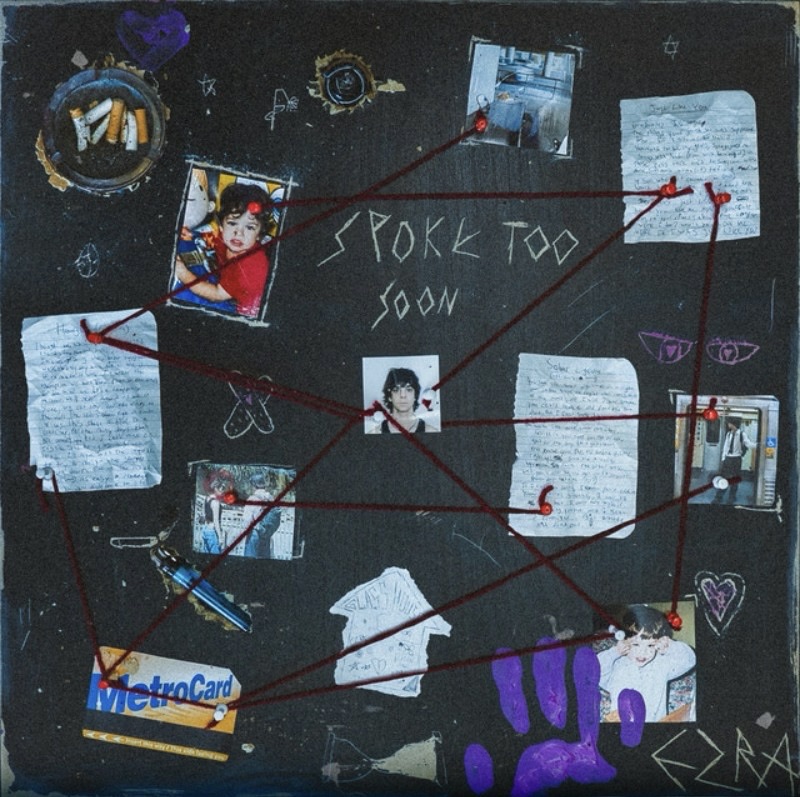
Emerging alt-pop artist “EZRA” known for turning and creating emotional difficult moments into authentic, intimate pop records. His debut album “Spoke Too Soon” introduces that perspective in full. The project explores situationships, emotional hesitation, and the fallout of premature confessions, positioning EZRA as a voice for love that exits in the grey area rather than the fairytale.
EZRA establishes the record’s emotional language: vocals and lyrics that sit somewhere between reflection and regret. Almost every track links back to timing, saying the wrong thing at the wrong moment, or realising feelings when it’s already too late to act on them.
The track “MIDDLE GROUND” which is one of the lead singles on the album portrays itself as an emotional centrepiece. It explores the stand-off of a relationship that exists without definition, intimate but cautious, committed but unspoken. EZRA’s performance is intentionally steady; he never over sings, which makes the tension more believable and the performance itself more authentic and real. The production reiterates that push-and-pull dynamic, pairing smooth pop clarity with a subtle undercurrent of unease.
If “MIDDLE GROUND” lives inside uncertainty, “looks so good” explores attraction with full awareness of its consequences. It’s bright on the surface, melodic, catchy, immediate, but lyrically it circles the experience of wanting someone you know is wrong for you. The contrast becomes the song’s strength: it sounds like infatuation while dissecting it. EZRA leans into that separation, letting the hook pull you in before the lyrics create their emotional weight.
SOURCE: SPOTIFY
The track “hourglass (feat Powfu),” the focus of the track is shift in time, how relationships can feel suspended before suddenly expiring. Powfu’s feature doesn’t overpower the track; instead, his understated delivery blends into EZRA’s world, reinforcing the reflective tone. The song feels patient, almost weightless, allowing its theme to unfold gradually rather than forcing impact.
On the track “sober cigarettes (feat. Scarlet House)” the introspection deepens. EZRA uses addiction imagery to talk about emotional dependence, the habit of returning to someone even when clarity says not to. Scarlet House adds a counterbalance, turning the track into a dialogue rather than a monologue. Their voices create a contrast that increases the song’s atmosphere, making it one of the album’s most immersive moments.
Halfway through the album, “intermission” arrives exactly when its title suggests it should. It’s brief and stripped back, acting as a pause rather than a centrepiece. After a run of emotionally dense songs, this track provides space to process what’s been said so far, almost like the silence after an argument where both people are replaying the conversation in their heads.
What makes “Spoke Too Soon” resonate isn’t just its subject matter, it’s EZRA’s refusal to resolve it neatly. There’s no dramatic closure, no cinematic redemption arc. Instead, the album accepts that some relationships end in ambiguity. Feelings linger, clarity comes late, and growth happens quietly.

PHOTO: JOSIE CRUZ
Vocally, EZRA’s restraint becomes one of his biggest strengths. He doesn’t go after vocal theatrics, he focuses and prioritizes on tone and phrasing, letting subtle cracks in delivery carry emotional weight. That choice makes the album feel conversational, as though each song is being told rather than performed.
“Spoke Too Soon” leaves less of an impassioned impact and more of a slow emotional imprint. It’s the kind of album that lingers because it mirrors real experiences, the relationships that never fully start, the confessions that come too early, the realisations that arrive too late. As a debut, it’s remarkably self-aware. EZRA doesn’t try to define lobe in grand terms; he focuses on its miscommunications and its unfinished sentences. That specificity is what makes the album compelling.
“Spoke Too Soon” ultimately succeeds because it understands something simple but difficult: heartbreak isn’t always loud. Sometimes it’s quiet timing, quiet regret, and learning to sit with both.