
A breath of fresh air, Maine’s very own Milk St is finally blessing the public with new music—and I got to talk to them about it. Jonah (he/him), Jordan (all pronouns), and Harry (he/him) met with me right before their show at the New Brunswick venue ‘Sunday School’ and let me into the future—not so far away now—plans for the band.
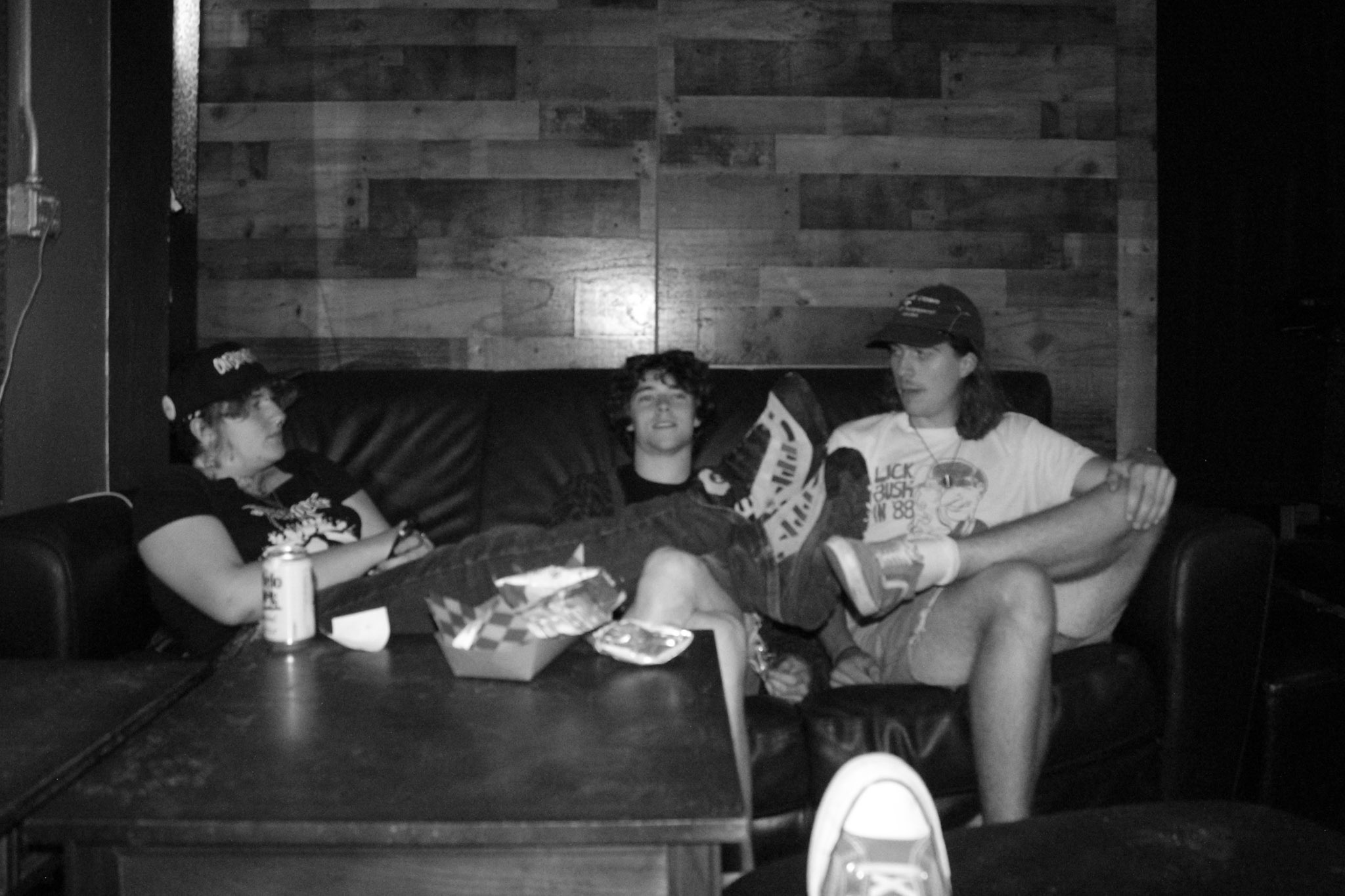
PHOTO: KENZIE TRIKOUROS
Angie: I want to start asking you about the origin of the band. How did you come up with the name? How did you guys come together to do what you do? What’s your purpose? What do you expect to do with the band? Go ahead.
Jonah: So, I started writing a lot of the songs when I was fourteen. I started playing guitar when I was eight, and then writing when I was like twelve. I didn’t have bandmates growing up, so I had a lot of rough demos, and then I moved to Bangor, Maine and I met Harry there. I had started at a different band—or the same band, a different name. We released our first LP, but it ended up being more of like a demo tape type thing. Without Harry involved. I started writing, working, and brought back a lot of songs I wrote when I was 14 to 17. And some new ones. Our bassist at the time was named Gabe, and we wrote this album called Vermont. I met Jordan with Gabe at a Slaughter Beach Dog show.
Harry: Or Tiger Show. We can’t remember.
Jonah: We just kept in touch. They were in other bands. Harry wrote all the drums and ended up writing a lot of the guitar for that Vermont record. Then it just snowballed. We ended up playing like a hundred and seventy shows in 2024. We did like a huge forty-day tour from Ottawa to Maine, Chicago, Toronto, in Florida and back. It’s always been kind of a family thing. Harry’s not going to be touring with us anymore as much. Only local shows and stuff, but we’re gonna still write together. And Jordan’s one of like two or three bassists that I have. So, it’s like whoever I’m around at a given time ends up being involved with the project.
Angie: What can you tell me about the name of the band? How did you come to be Milk St?
Jonah: This happened in Boston. Gabe and I had bonded over Joyce Manor a lot. And we went and saw them finally, and we were trying to get back to Maine really fast because we had school the next day. We were going to college. So, we whipped out of there as fast as we could. We were talking about a name for the band, and we almost rolled our van into this huge white sign that said Milk Street. Massive, and Gabe was like “that’s the name then”. It was called Spaced before. So, they ended up releasing the Vermont record with Harry, and then a year ago now, we recorded a record, and we just recorded a music video for it today. Jordan ended up doing vocals on it. So, it’s finally getting mastered and we’re getting music videos out this year.
Angie: So, you have a record already?
Jonah: It’s called ‘Good Grief’. ‘Vermont’ was a very conceptual record about real life experiences. ‘Good Grief’ isn’t conceptual. When I sat down to organize the songs, to create an order, it ended up being very linear—at least for me, because it was like, “Oh, I wrote this song when this was going on, and this song when this was going on.”
Angie: Would you say that it tells a story?
Jonah: Because I was trying to figure out music video ideas, I ended up sitting down for like four hours and basically wrote a novel style outline for it. All the songs lined up perfectly and I was also trying to look for other art forms—outlets. So, I started writing a lot of poetry, spontaneous prose type stuff. I ended up having three or four huge notebooks of stuff. So, I’m thinking we’re gonna release a book, like a poetry book, alongside the record. They’ll come bundled together and it’ll be ‘Good Grief’ [the album]. The last song on the record, as of right now, I’m pretty sure it’s going to be called So On. And then the book is going to be called Or Whatever. The record is very much about apathy, and about, not even loss, but learning that you just can’t control most things in your life and having to navigate away from apathy to radical acceptance. I was having a really bad dissociative disorder at the time.
Angie: In your creative process, are you the one that writes all the lyrics or is it collaborative?
Harry: I can’t say anything about the lyrics, but I have a lot to say about the music. A lot of what was written was developed on the road for this last record. And I think a lot of it came from one, talking about that stuff, but also us trying things on stage. So, a lot of what you hear is made from those hundred and forty shows that we played in 2024. And I would say, as much as I love the songwriting on the record, it’s more about the live energy that Gabe and I brought to it at the time. I think the collaborative part happened supernaturally. Writing the lyrics and the chord progressions is the first level of any song. And then anything above that is all of the aesthetic meaning and all of the intricate musical stuff that makes something indie rock or slowcore, or whatever post post genre you want to call it, right? I would say that’s my biggest contribution to the band.
Jonah: And, like Harry said, some of those songs were like, I had the chords and lyrics written down, and then Harry would, especially on this record, add a ton of lead guitar.
Harry: And that studio work doesn’t come from live stuff. That came from a lot of time spent listening to him record songs. There was a lot of creative stuff that happened in the studio, but just a little bit of insight into the record: we recorded all of it as a three-piece live in the room. So, you’re hearing some form of the live show that we had at the time in the record, as the basis. And then everything else above it is kind of all of us flattering the paint a little bit.
Jonah: And with Vermont, I think that we also felt like we put too many layers on it. And our original intention with the new record is to have less and make it feel live. Our producer Cade Earick is a super amazing person. And they ended up playing, like, saxophone on it and piano.
Harry: I also do think it’s the nature of the project. I think we’ve never really gone to make anything and had it be minimal.
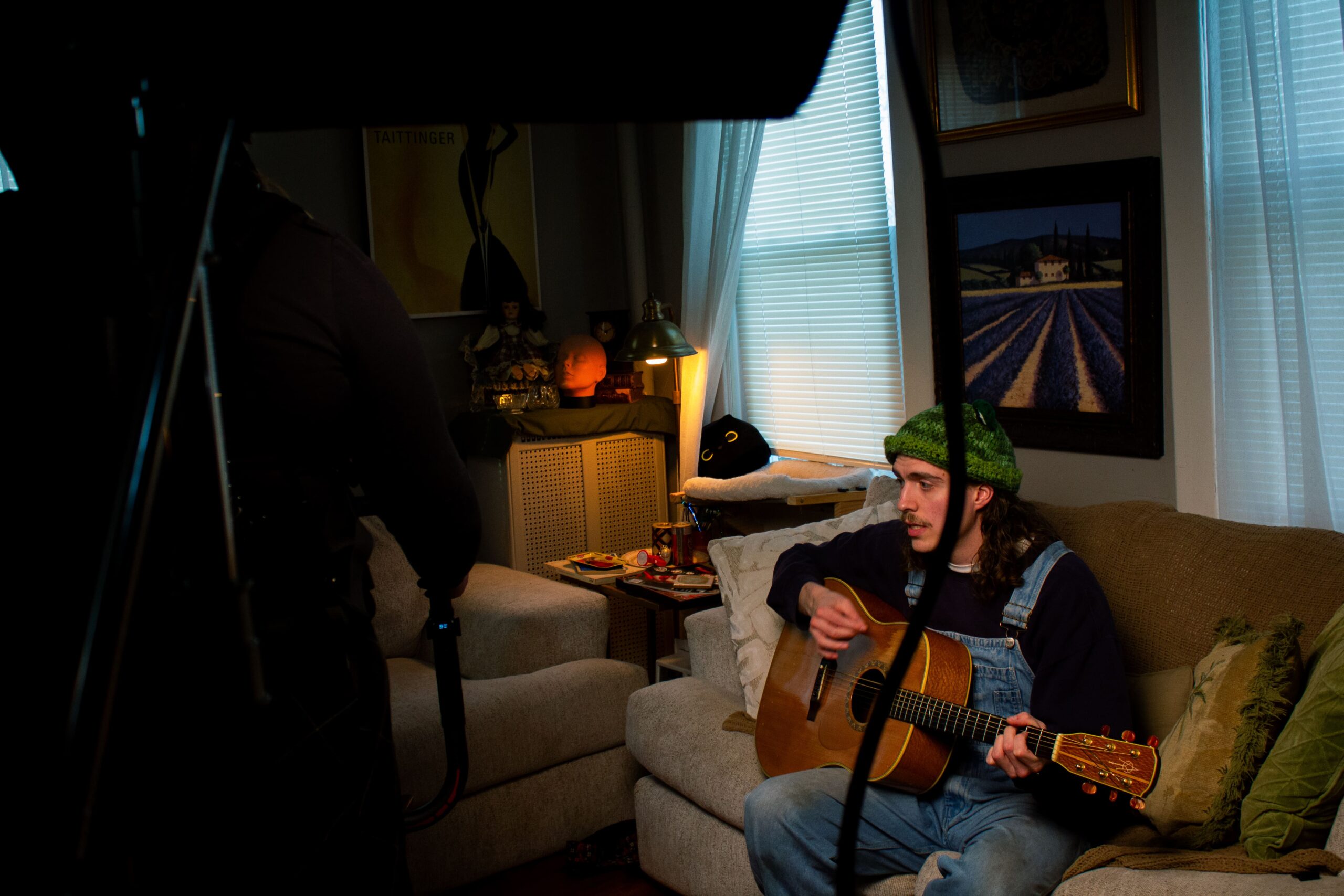
PHOTO: BREA YUMIGUANO (GOOD GRIEF MUSIC VIDEO BTS)
Jonah: Since I moved to New Hampshire it’s become a different process where I’ve written newer songs that aren’t on the record and sent them to Harry. He’s recorded drums, sent them back, and then at some point we’ve gotten together and courted different things, or flushed certain things out. It’s become a whole different process.
Harry: And I mean, what are you doing if you’re not evolving in that?
Jonah: Yeah, it’s cool that it’s constantly changing, not just musically, but how we approach it. This record is way more big sounding, and there are electric guitars, and a lot of fuzz, and things like that. I’m super, super proud of everything that we’ve done on it.
Angie: So, if you live in New Hampshire, Boston, and Maine, how do you work together? Virtually?
Harry: Well, I well, we don’t really anymore. Okay. A lot of what we’re talking about is kind of a relic of how the band worked. We work very differently now. And, you know, the last times that we’ve gotten together have been for tours, not for fun, not for recording, not for writing.
Jonah: At first it was a difficult change for me. Songwriting became lonely. A lot of times all of the writing happened as a group. And now I kind of come up with a bunch of ideas and I’ve written like forty songs as opposed to five. So, I’m trying to flesh those out now and finish them. We’ve kind of approached it from different angles this whole time, which has been cool. So, it just changed. It’s not better or worse. It’s just different. And I think that’s healthy as an artist, and I think that helps me develop. Like I said, at first it felt lonely and eventually I started to feel more confident.
Angie: Talk to me about this new album that you’re gonna put out. Can you tell me how many songs?
Jonah: Thirteen? With the intro and the outro.
Angie: What would you say is your favorite song off the album?
Jonah: From a consumer experience? Probably Montana. I think it has the most reservations and pulls the most punches. And when I play it, it feels like someone is getting something else. Every time. It hasn’t faded at all in the two years we’ve been playing it.
Angie: What would you say is your favorite one to perform?
Jonah: Ooh. Apple Pie. That one is fun, yeah, that one’s actually really fun to play with the full band. Yeah, it is a good one.
Harry: As a consumer. There’s a song called Just So. It’s a pop song. I just think it’s really well done. It’s a good melody. Can I give a least favorite?
Angie: Yes.
Harry: Wrong Complement. It’s too long. It’s folk-punky. Okay. And it has a train beat. Not fun to play.
Jordan: Milk and Honey. I really like Just So a lot, too. I think the vocal line is really fun. Slide Up is really fun for me to play on bass, because I get to turn on all my big pedals and sound really big and nasty. But Milk and Honey is definitely my favorite. It’s got the most interesting chord lines to me. And it feels like kind of an outlier to a lot of the stuff. And I think that’s why I like it because it’s like so out there and interesting
Jonah: It’s interesting because every song kind of has a place on the record. Montana is very spatial. Boy Dinner sounds like a Joyce Manor song or older Blink-182. Weed and Crisco feels like a 90s, Modest Mouse style song. Everything has a cool place and its own identity, which is something I really like because Vermont was one big piece. Some of the songs, I think, get lost in the mess.
Angie: What would you say was your inspiration, in general, for this album? Did you have any artists or any albums that you used as references?
Harry: By the time we recorded the record I had gotten the whole band into Black Country, New Road. They’re like a post-rock kind of band. That influence. And the longer song forms, the more like intricate song forms, came from Black Country, New Road.
Jonah: I got super into Modest Mouse. Weed and Crisco is a derivative of Modest Mouse.
Jordan: I wasn’t on the record much, but the way I play for live sets comes from hardcore. And I am very focused on keeping a certain energy with the songs. The way I approach music is a very ‘suspense and release’ way. And I try to follow that pattern. Sophisticated Adult is a really good local band. I really like Haywire. I love Unbroken Wings. There’s also FFO Chillen. It’s a hardcore indie band that’s really good. There’s a band called Jeeze, who are also from Maine. They’re really cool. But I also love emo. One of my favorite bands from around where I live in Boston is called Dino Gala. They’re really cool. I love Harry’s band, Gunshot Glitter. I think he’s just a fantastic player. I approach music from a standpoint of building up suspense and then releasing—trying to hold an audience captive. Losing attention as a musician is the last thing you want to do.
Angie: What would you say was your favorite release of 2025?
Jordan: Very out of character for me because I’m not a big fan of Shoegaze, but TAGABOW’s [They Are Gutting a Body of Water] recent record. LOTTO.
Harry: I have a similar answer. I really like the new TAGABOW record, of course, too. Bassvictim’s album was super inspirational for me. All the people surrounding Bassvictim, I think, are so cool. All that whole Copenhagen scene. I think there’s a lot happening in electronic music that us 90’s revivalists can learn from. There’s a lot of implementations of traditional song craft along with really pushing the boundaries of the aesthetics and, you know, washing stuff out, abstracting things. I think it’s great.
Jordan: I would like to add another answer. SIN AGAINST SIN. It’s a hardcore band from my neck of the woods in Boston. And they have some New York members, but their recent demo. It’s only 4 songs, but it is some of the coolest fucking music I have ever heard. [DEMO 2]
Jonah: I have three albums that I compulsively listen to half of. I love every other song and don’t care for the rest. The new Geese record [Getting Killed]. The new Wednesday record [Bleeds]. And the new Big Thief record [Double Infinity].
Angie: Do you have a release date for the record?
Jonah: Late summer, early fall. Singles will start coming out way sooner.
Angie: You have a couple music videos lined up, right?
Jonah: Like three. Three.
Angie: How many singles are you going to have?
Jonah: I’m thinking of releasing a whole record of singles. A single every three months for two years. Haha.
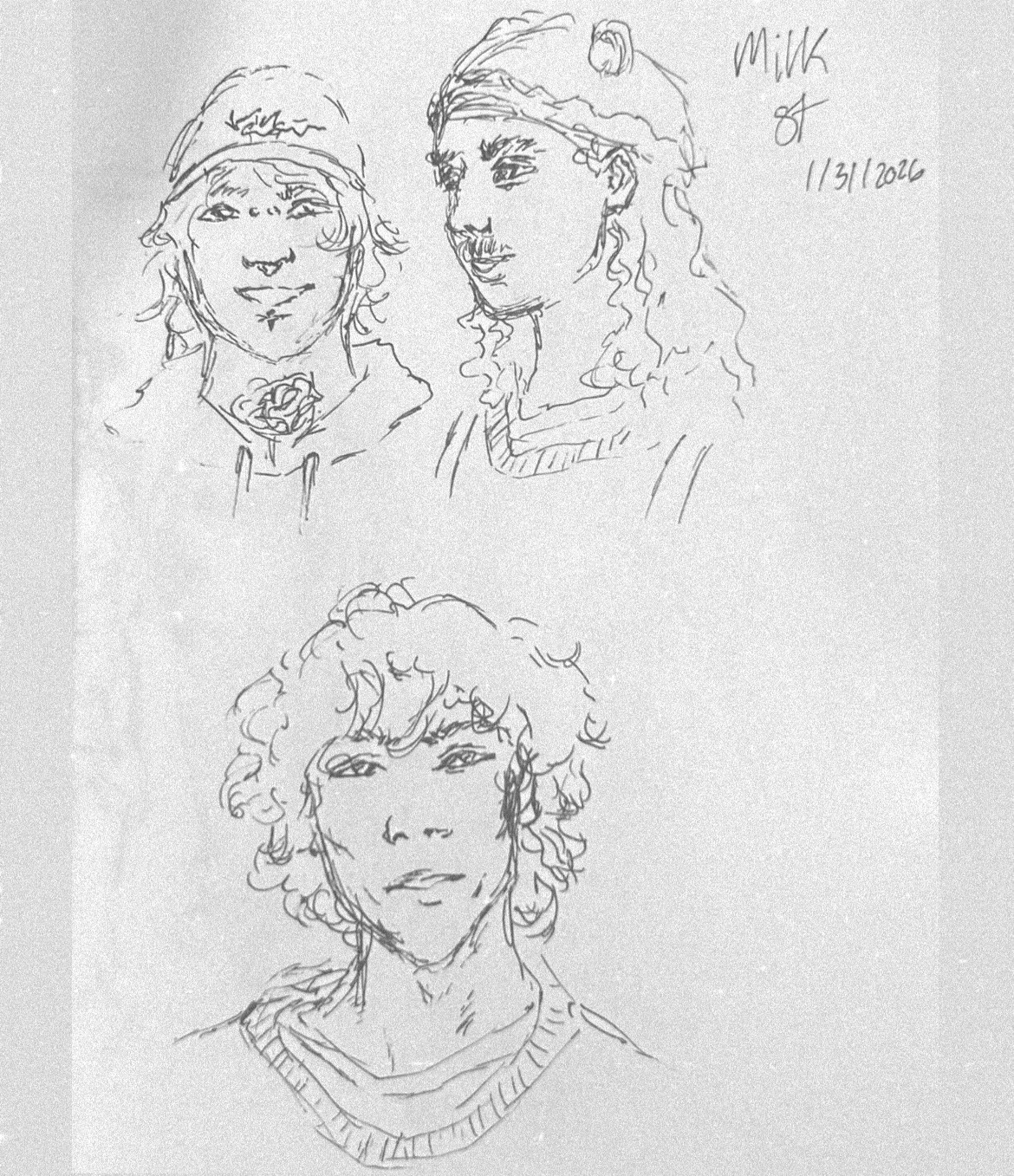
ARTIST: CAELAN KOPACZ